Every successful SpaceX rocket launch since 2008
10,000 launches a year by 2030?
Elon Musk says SpaceX will get there. Here is what the launch record says.
718 successful SpaceX launches so far, each one a dot on the charts below.
Projected year
Projection method · five statistical approaches
Compare all five for 2030
Every point = one flight. Each point shows the preceding 365 days. 1 Falcon 9 equivalent = 22.8 tonnes of estimated payload. White dashed lines continue the fitted growth. How this works.
Archive checked 3 Oct 2026
Our view
How Elon gets to 10,000
We think he will. The curves fitted to past launches cannot see what changes next: a fully reusable Starship.
This is our view, not a measurement. The observed flights and the four fitted methods above show what the record alone says; “Elon’s path” shows the pace his target requires.
Bend the curve.
What could the next three months do to a 10,000-launch future?
Calculating the three-month launch requirement…
Fits the latest three complete years, then rolls that window forward. This shows what would move the fitted curve to 10,000 launches a year in 2030; it is a scenario, not a launch plan.
Refitted 2030 pace
How the three-year calculation works
The recent three-year curve implies — actual launches a year in 2030. This calculator uses the latest three complete calendar years with recorded launches. Each year has equal weight in a straight-line least-squares fit to the logarithm of annual launch counts. The top-of-page charts retain their longer historical fit.
We add hypothetical successful launches to the saved records, evenly spaced over the next three calendar months, then refit to the latest three complete years at the end of that window. The oldest year drops out when a new year is completed. Dates use UTC; the end date is exclusive. Records already in the archive are retained. No other new launches are assumed.
The headline is the smallest whole launch count whose refitted 2030 value reaches at least 10,000. It is a hypothetical sensitivity calculation, not evidence that the target is feasible. It always counts actual successful flights, independent of the Falcon 9 equivalents toggle above.
Musk’s reported 10,000-a-year ambition refers specifically to Starship. This experiment tests that numerical target against the site’s broader SpaceX launch history.
Big possibilities.
Real launch history.
The story started with 705 successful flights. Every new confirmed success adds a point. Each point shows the preceding 365 days of launch activity, with payload estimates matched to published records. Tap the graph to inspect a flight.
Ask your AI about the launch data
Connect any MCP client to https://eloncurves.com/mcp with your access token. The tools read the same saved data and fitted curves shown here.
Try: “Compare launch cadence and tonnes lifted at the end of 2020, 2023 and 2025.” Or: “What annual payload and Falcon 9 equivalents does the curve imply for 2030?” You can also ask for monthly totals, individual flights and their payload sources.
Every answer includes data freshness. Recorded activity and projected growth are labelled separately. Unknown payload masses remain unknown.
Which flights are included?
The original study selected the first 705 flights marked “Success” in Space Launch Schedule. This site now includes all 718 successful records from that downloaded archive, through 1 October 2026, and adds new confirmed SpaceX successes from Launch Library 2.
Historical classifications are retained, including short Starship test hops and the Dragon abort test. They count as flights but add no payload mass carried to space. Upcoming, failed and unconfirmed launches are excluded.
What does “payload” include?
Satellites, Dragon spacecraft and cargo, and mass simulators, in tonnes of 1,000 kg. Rocket structure and propulsion are excluded. Some Starship cargo followed suborbital trajectories, so this is mass carried to space, not all mass left in orbit.
Masses come from Jonathan McDowell’s GCAT catalogue and include estimates. For Starship, we add the separate payload objects and exclude the vehicle’s own 120 tonnes. Classified payloads and Flight 12 are particularly uncertain; the CSV retains the sources and notes.
What is a Falcon 9 equivalent?
Why Starship barely moves the curve yet. The charts count payload actually carried, not rocket capacity. Starship can in principle lift around 100–150 tonnes, the work of five or more Falcon 9s, but its flights so far carried test payloads of 0–52 tonnes, and it has flown 15 of the 718 recorded launches. When Starship flies full loads often, each flight will count as several Falcon 9 equivalents and the payload curve will steepen. The 22.8-tonne unit is Falcon 9’s maximum expendable payload; typical reusable Starlink flights carry less, so the unit slightly understates how many Falcon 9 flights a tonnage would take.
One equivalent is 22.8 tonnes of payload, based on SpaceX’s published maximum payload to low Earth orbit. We divide each rolling payload total and the fitted payload curve by 22.8. For example, 228 tonnes equals 10 Falcon 9 loads.
This measures payload mass in a fixed unit, rather than counting flights. It does not say how many Falcon 9 launches a mission would actually require: capacity varies with destination and recovery, and our payload archive includes some suborbital missions. Choose “Actual launches” to see the flight count. Both views retain a point for every recorded flight.
Dividing by a fixed number preserves the payload curve’s shape and percentage growth. The steeper growth compared with actual launch counts comes from the estimated payload data.
How are the curves fitted?
There is one observed point per successful flight, at its actual launch date. Its height is the launch count, known payload tonnes, or Falcon 9 payload equivalents in the preceding 365 days. Tap a point to see the flight and its individual payload estimate.
The smooth curves fit complete calendar-year totals from 2017 onward, with equal weight per year, by fitting the logarithm of annual totals. Annual totals are anchored at year-end. The current incomplete year is excluded. Payload years containing missing estimates are also excluded.
The 2020–2040 slider shows the fitted or projected pace at the end of the selected year. Projections are scenarios that continue historical growth, not predictions of actual launch capacity.
How much should I trust the projection?
It is a historical growth scenario. The original 705-flight snapshot showed a 2026 pace below the fitted curve. Observed flight-by-flight totals now show how the pace develops as new flights arrive. Extrapolating as far as 2040 compounds these assumptions dramatically; those values illustrate the mathematics, not an expected launch capacity.
The model does not explicitly account for Starship’s ramp-up, launchpad capacity, demand, reliability or regulation. The fit window also matters: 2020–2025 would imply about 1,316 launches in 2030, compared with 775 here. The original downloadable study includes that sensitivity check.
Sources and credits
- Space Launch Schedule — dates and outcomes.
- GCAT, Jonathan C. McDowell — payload catalogue, release 1.8.8; credited under CC BY.
- Launch Library 2 / The Space Devs — new flights and confirmed outcomes.
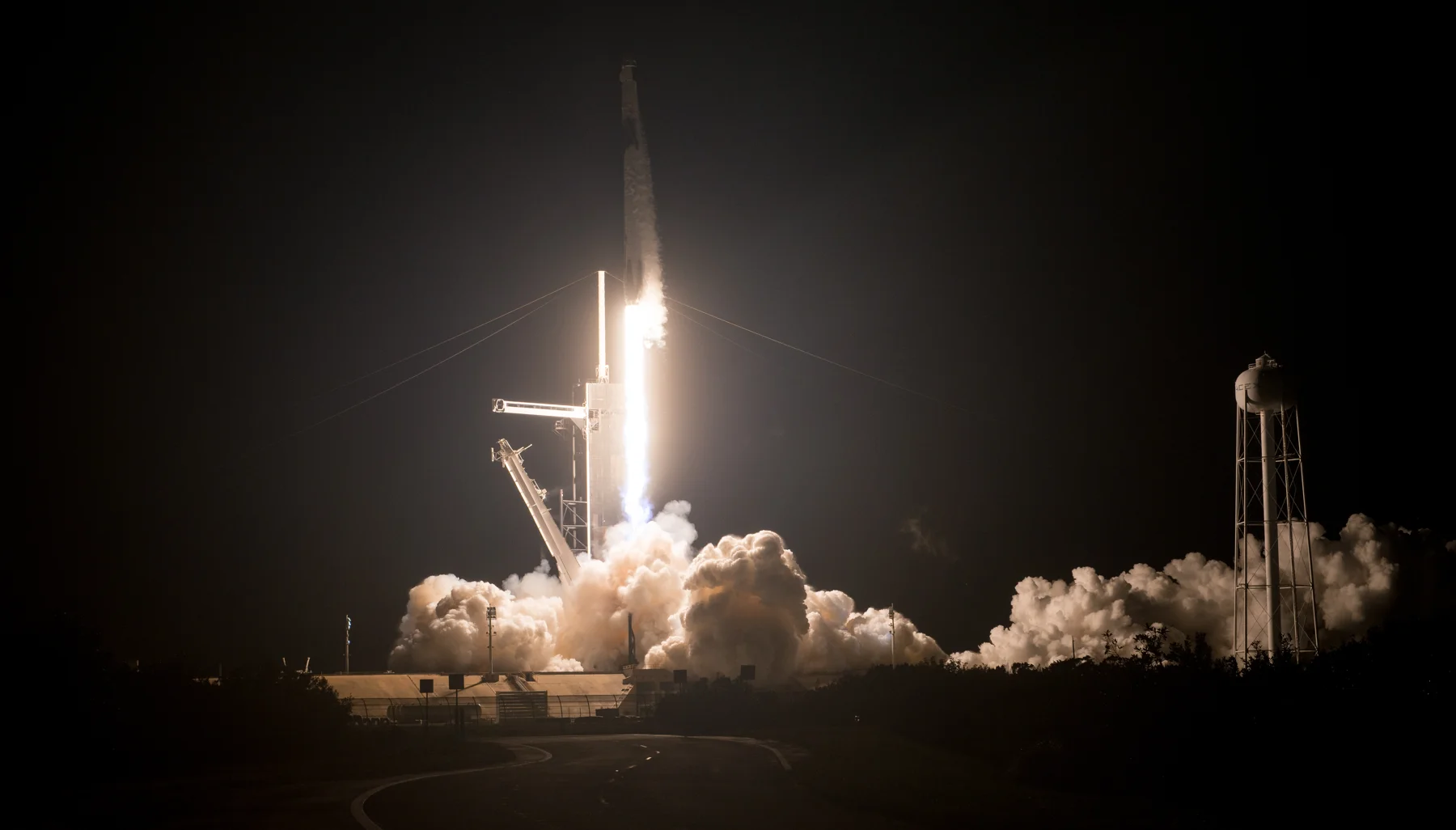
- Launch photograph: NASA / Aubrey Gemignani, Crew-1, NHQ202011150030.
Original study prepared 3 October 2026. The daily updater makes one launch-API request per day and refreshes GCAT estimates. Missing mass stays unknown; hollow points indicate incomplete tonnage. If a source fails, the last saved data remains visible. The original study download remains a fixed historical snapshot.